Prostate biopsy
Prostate biopsy is a procedure in which small hollow needle-core samples are removed from a man's prostate gland to be examined for the presence of cancer. It is typically performed when the result from a PSA blood test rises to a level that could indicate prostate cancer.
Procedure[edit]
A prostate biopsy is performed by a urologist, who may use ultrasound guidance. The patient is usually given a local anesthetic. The procedure involves inserting a needle into the prostate gland, which is located in front of the rectum, and removing a small sample of tissue. The procedure is usually performed in the doctor's office and takes about 10 minutes.
Risks[edit]
Like any procedure, a prostate biopsy carries risks. These may include bleeding, infection, and difficulty urinating. There is also a small risk that the biopsy will miss a cancer that is present in the prostate.
Results[edit]
The tissue samples are sent to a laboratory, where a pathologist examines them under a microscope. If cancer cells are found, the pathologist will also determine the Gleason score, which helps predict the aggressiveness of the cancer.
Follow-up[edit]
If the biopsy results show cancer, the patient and doctor will discuss treatment options. These may include surgery, radiation therapy, hormone therapy, or active surveillance.
See also[edit]

This WikiMD article can only be edited by registered and verified editors. You can log in or register.
-
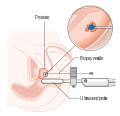 Diagram showing a transperineal prostate biopsy
 -
 Targeted MRI-US fusion prostate biopsy at UCLA
 -
 Post Transperineal Biopsy


Medical Disclaimer: WikiMD is for informational purposes only and is not a substitute for professional medical advice. Content may be inaccurate or outdated and should not be used for diagnosis or treatment. Always consult your healthcare provider for medical decisions. Verify information with trusted sources such as CDC.gov and NIH.gov. By using this site, you agree that WikiMD is not liable for any outcomes related to its content. See full disclaimer.
Credits:Most images are courtesy of Wikimedia commons, and templates, categories Wikipedia, licensed under CC BY SA or similar.
Translate page: - East Asian
中文,
日本,
한국어,
South Asian
हिन्दी,
தமிழ்,
తెలుగు,
Urdu,
ಕನ್ನಡ,
Southeast Asian
Indonesian,
Vietnamese,
Thai,
မြန်မာဘာသာ,
বাংলা
European
español,
Deutsch,
français,
Greek,
português do Brasil,
polski,
română,
русский,
Nederlands,
norsk,
svenska,
suomi,
Italian
Middle Eastern & African
عربى,
Turkish,
Persian,
Hebrew,
Afrikaans,
isiZulu,
Kiswahili,
Other
Bulgarian,
Hungarian,
Czech,
Swedish,
മലയാളം,
मराठी,
ਪੰਜਾਬੀ,
ગુજરાતી,
Portuguese,
Ukrainian

