Unhappy triad
| Unhappy triad | |
|---|---|
| Knee diagram.svg | |
| Synonyms | N/A |
| Pronounce | N/A |
| Specialty | N/A |
| Symptoms | N/A |
| Complications | N/A |
| Onset | N/A |
| Duration | N/A |
| Types | N/A |
| Causes | N/A |
| Risks | N/A |
| Diagnosis | N/A |
| Differential diagnosis | N/A |
| Prevention | N/A |
| Treatment | N/A |
| Medication | N/A |
| Prognosis | N/A |
| Frequency | N/A |
| Deaths | N/A |
The unhappy triad, also known as the terrible triad, is a severe knee injury pattern that involves damage to three critical structures of the knee joint: the anterior cruciate ligament (ACL), the medial collateral ligament (MCL), and the medial meniscus. This injury is commonly associated with contact sports and activities that involve sudden changes in direction or impact to the knee.
Anatomy and Mechanism of Injury[edit]
The knee joint is a complex hinge joint that allows for flexion, extension, and slight rotation. It is stabilized by several ligaments and supported by the menisci, which are cartilaginous structures that cushion the joint.
- The anterior cruciate ligament (ACL) is a key stabilizer that prevents the tibia from sliding forward relative to the femur.
- The medial collateral ligament (MCL) provides medial stability to the knee, preventing it from bending inward.
- The medial meniscus acts as a shock absorber and stabilizer between the femur and tibia.
The unhappy triad typically occurs when a lateral force is applied to the knee while the foot is planted, causing the knee to twist inward. This mechanism often results in a tear of the ACL, MCL, and medial meniscus.
Clinical Presentation[edit]
Patients with an unhappy triad injury often present with:
- Severe pain and swelling in the knee
- Instability or a feeling of the knee "giving way"
- Difficulty bearing weight on the affected leg
- Limited range of motion
Diagnosis[edit]
Diagnosis of the unhappy triad is typically made through a combination of physical examination and imaging studies.
- Physical Examination: Tests such as the Lachman test, valgus stress test, and McMurray test can help assess the integrity of the ACL, MCL, and meniscus, respectively.
- Imaging: Magnetic resonance imaging (MRI) is the gold standard for visualizing soft tissue injuries in the knee.
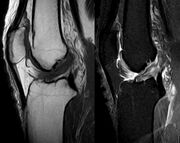
MRI showing ACL tear

Treatment[edit]
Treatment of the unhappy triad often involves both surgical and non-surgical approaches:
- Non-Surgical: Initial management may include rest, ice, compression, and elevation (RICE), along with physical therapy to restore range of motion and strengthen surrounding muscles.
- Surgical: Surgical intervention is often required to repair or reconstruct the torn ligaments and meniscus. ACL reconstruction is commonly performed using a graft, while the MCL and meniscus may be repaired or left to heal naturally, depending on the severity of the injury.
Prognosis[edit]
The prognosis for patients with an unhappy triad varies depending on the severity of the injury and the success of the treatment. With appropriate management, many patients can return to their previous level of activity, although some may experience long-term issues such as knee instability or osteoarthritis.
Also see[edit]

Medical Disclaimer: WikiMD is for informational purposes only and is not a substitute for professional medical advice. Content may be inaccurate or outdated and should not be used for diagnosis or treatment. Always consult your healthcare provider for medical decisions. Verify information with trusted sources such as CDC.gov and NIH.gov. By using this site, you agree that WikiMD is not liable for any outcomes related to its content. See full disclaimer.
Credits:Most images are courtesy of Wikimedia commons, and templates, categories Wikipedia, licensed under CC BY SA or similar.
Translate page: - East Asian
中文,
日本,
한국어,
South Asian
हिन्दी,
தமிழ்,
తెలుగు,
Urdu,
ಕನ್ನಡ,
Southeast Asian
Indonesian,
Vietnamese,
Thai,
မြန်မာဘာသာ,
বাংলা
European
español,
Deutsch,
français,
Greek,
português do Brasil,
polski,
română,
русский,
Nederlands,
norsk,
svenska,
suomi,
Italian
Middle Eastern & African
عربى,
Turkish,
Persian,
Hebrew,
Afrikaans,
isiZulu,
Kiswahili,
Other
Bulgarian,
Hungarian,
Czech,
Swedish,
മലയാളം,
मराठी,
ਪੰਜਾਬੀ,
ગુજરાતી,
Portuguese,
Ukrainian

