Adenosine diphosphate ribose
Adenosine diphosphate ribose (ADP-ribose) is a molecule that plays a significant role in various biological processes. It is a derivative of adenosine diphosphate (ADP) and ribose, a type of sugar.
Structure and Synthesis[edit]
ADP-ribose is composed of an adenosine molecule attached to two phosphate groups and a ribose sugar. The synthesis of ADP-ribose is catalyzed by the enzyme ADP-ribosyltransferase, which transfers the ADP-ribose group from nicotinamide adenine dinucleotide (NAD+) to a target protein.
Function[edit]
ADP-ribose plays a crucial role in several cellular processes, including DNA repair, gene regulation, and cell signaling. It is involved in the process of ADP-ribosylation, a post-translational modification of proteins that regulates their function. In addition, ADP-ribose serves as a precursor for the synthesis of cyclic ADP-ribose, a molecule that acts as a second messenger in calcium signaling.
Role in Disease[edit]
Alterations in the metabolism of ADP-ribose have been associated with various diseases, including cancer, neurodegenerative disorders, and inflammation. For instance, mutations in the genes encoding ADP-ribosyltransferases can lead to the development of certain types of cancer. Moreover, the accumulation of ADP-ribose has been implicated in the pathogenesis of neurodegenerative diseases such as Alzheimer's disease and Parkinson's disease.
See Also[edit]
References[edit]

Adenosine_diphosphate_ribose[edit]
-
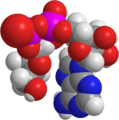 ADP-ribose 3D
 -
 Three-dimensional model of ADP ribose


Medical Disclaimer: WikiMD is for informational purposes only and is not a substitute for professional medical advice. Content may be inaccurate or outdated and should not be used for diagnosis or treatment. Always consult your healthcare provider for medical decisions. Verify information with trusted sources such as CDC.gov and NIH.gov. By using this site, you agree that WikiMD is not liable for any outcomes related to its content. See full disclaimer.
Credits:Most images are courtesy of Wikimedia commons, and templates, categories Wikipedia, licensed under CC BY SA or similar.
Translate page: - East Asian
中文,
日本,
한국어,
South Asian
हिन्दी,
தமிழ்,
తెలుగు,
Urdu,
ಕನ್ನಡ,
Southeast Asian
Indonesian,
Vietnamese,
Thai,
မြန်မာဘာသာ,
বাংলা
European
español,
Deutsch,
français,
Greek,
português do Brasil,
polski,
română,
русский,
Nederlands,
norsk,
svenska,
suomi,
Italian
Middle Eastern & African
عربى,
Turkish,
Persian,
Hebrew,
Afrikaans,
isiZulu,
Kiswahili,
Other
Bulgarian,
Hungarian,
Czech,
Swedish,
മലയാളം,
मराठी,
ਪੰਜਾਬੀ,
ગુજરાતી,
Portuguese,
Ukrainian

