Allyl isothiocyanate
-
 2D skeletal structure of Allyl isothiocyanate
 -
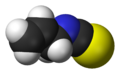 3D van der Waals model of Allyl isothiocyanate


Allyl isothiocyanate[edit]
Allyl isothiocyanate (AITC) is an organic compound with the formula CH_CHCH_NCS. It is a colorless oil with a pungent odor, commonly associated with mustard and horseradish. AITC is a member of the isothiocyanate family, which are compounds containing the functional group -N=C=S.
Chemical Properties[edit]
Allyl isothiocyanate is a volatile compound that is slightly soluble in water but more soluble in organic solvents. It is known for its ability to form thiourea derivatives when reacted with amines. The compound is stable under normal conditions but can decompose at elevated temperatures.
Natural Occurrence[edit]
AITC is naturally found in plants of the Brassicaceae family, such as mustard, horseradish, and wasabi. It is produced from the enzymatic hydrolysis of sinigrin, a glucosinolate, by the enzyme myrosinase. This reaction occurs when plant tissues are damaged, releasing the pungent compound as a defense mechanism against herbivores.
Uses[edit]
Allyl isothiocyanate is used as a flavoring agent in foods, imparting a spicy and pungent taste. It is also employed as a preservative due to its antimicrobial properties. In agriculture, AITC is used as a natural pesticide and fungicide.
In the laboratory, AITC is used as a reagent for the synthesis of other chemical compounds. It is also studied for its potential health benefits, including anti-cancer and anti-inflammatory properties.
Safety[edit]
Allyl isothiocyanate is an irritant to the skin, eyes, and respiratory system. Proper handling and protective equipment are recommended when working with this compound. Ingestion or inhalation of large amounts can be harmful.
Related Pages[edit]
| Organic compounds | ||||||||||
|---|---|---|---|---|---|---|---|---|---|---|
This organic compounds related article is a stub.
|

Medical Disclaimer: WikiMD is for informational purposes only and is not a substitute for professional medical advice. Content may be inaccurate or outdated and should not be used for diagnosis or treatment. Always consult your healthcare provider for medical decisions. Verify information with trusted sources such as CDC.gov and NIH.gov. By using this site, you agree that WikiMD is not liable for any outcomes related to its content. See full disclaimer.
Credits:Most images are courtesy of Wikimedia commons, and templates, categories Wikipedia, licensed under CC BY SA or similar.
Translate page: - East Asian
中文,
日本,
한국어,
South Asian
हिन्दी,
தமிழ்,
తెలుగు,
Urdu,
ಕನ್ನಡ,
Southeast Asian
Indonesian,
Vietnamese,
Thai,
မြန်မာဘာသာ,
বাংলা
European
español,
Deutsch,
français,
Greek,
português do Brasil,
polski,
română,
русский,
Nederlands,
norsk,
svenska,
suomi,
Italian
Middle Eastern & African
عربى,
Turkish,
Persian,
Hebrew,
Afrikaans,
isiZulu,
Kiswahili,
Other
Bulgarian,
Hungarian,
Czech,
Swedish,
മലയാളം,
मराठी,
ਪੰਜਾਬੀ,
ગુજરાતી,
Portuguese,
Ukrainian

