Anaerobic exercise
-
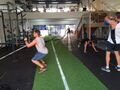 Small group fitness sessions
 -
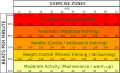 Exercise zones by Fox and Haskell
 -
Anaerobic exercise


Anaerobic Exercise[edit]
Anaerobic exercise refers to a category of physical activity that involves short bursts of high-intensity effort where the demand for oxygen exceeds the oxygen supply. This type of exercise relies on energy sources that are stored in the muscles and, unlike aerobic exercise, does not rely on the cardiovascular system to deliver oxygen to the muscles.
Physiology[edit]
Anaerobic exercise primarily uses the adenosine triphosphate (ATP) and creatine phosphate systems for energy. These systems provide energy quickly but are limited in duration. The glycolytic pathway is also involved, where glucose is broken down to produce ATP, resulting in the production of lactic acid. This accumulation of lactic acid is often associated with the "burn" felt during intense exercise.
Types of Anaerobic Exercise[edit]
Anaerobic exercises include activities such as:
These activities are characterized by short duration and high intensity, typically lasting from a few seconds to about two minutes.
Benefits[edit]
Anaerobic exercise offers several benefits, including:
- Increased muscle mass and strength
- Improved metabolic rate
- Enhanced bone density
- Better insulin sensitivity
- Increased anaerobic threshold
Considerations[edit]
Anaerobic exercise is demanding on the body and requires proper technique to prevent injury. It is important to include adequate warm-up and cool-down periods, and to ensure proper nutrition and hydration.
Related Pages[edit]
| Exercise | ||||
|---|---|---|---|---|
|

Medical Disclaimer: WikiMD is for informational purposes only and is not a substitute for professional medical advice. Content may be inaccurate or outdated and should not be used for diagnosis or treatment. Always consult your healthcare provider for medical decisions. Verify information with trusted sources such as CDC.gov and NIH.gov. By using this site, you agree that WikiMD is not liable for any outcomes related to its content. See full disclaimer.
Credits:Most images are courtesy of Wikimedia commons, and templates, categories Wikipedia, licensed under CC BY SA or similar.
Translate page: - East Asian
中文,
日本,
한국어,
South Asian
हिन्दी,
தமிழ்,
తెలుగు,
Urdu,
ಕನ್ನಡ,
Southeast Asian
Indonesian,
Vietnamese,
Thai,
မြန်မာဘာသာ,
বাংলা
European
español,
Deutsch,
français,
Greek,
português do Brasil,
polski,
română,
русский,
Nederlands,
norsk,
svenska,
suomi,
Italian
Middle Eastern & African
عربى,
Turkish,
Persian,
Hebrew,
Afrikaans,
isiZulu,
Kiswahili,
Other
Bulgarian,
Hungarian,
Czech,
Swedish,
മലയാളം,
मराठी,
ਪੰਜਾਬੀ,
ગુજરાતી,
Portuguese,
Ukrainian


