Interferon-gamma receptor
Interferon-gamma receptor (IFNγR) is a type of protein that is encoded by the IFNGR1 gene in humans. It is a part of the interferon family, which are proteins that are produced and released by host cells in response to the presence of several pathogens, such as viruses, bacteria, parasites, and also tumor cells.
Structure[edit]
The IFNγR is composed of two subunits, IFNGR1 and IFNGR2. The IFNGR1 subunit is the ligand-binding chain (alpha), while the IFNGR2 subunit is the accessory chain (beta). Both of these subunits are necessary for signal transduction.
Function[edit]
The primary function of the IFNγR is to mediate the biological effects of IFNγ. When IFNγ binds to the receptor, it activates the JAK-STAT signaling pathway, which leads to the expression of certain genes that have antiviral, antitumor, and immune response functions.
Clinical significance[edit]
Mutations in the IFNGR1 gene can lead to a condition known as Mendelian susceptibility to mycobacterial disease, which is characterized by an increased susceptibility to certain mycobacterial infections. Additionally, IFNγR has been implicated in a number of autoimmune diseases, including multiple sclerosis and rheumatoid arthritis.
See also[edit]
- Interferon gamma
- Interferon
- JAK-STAT signaling pathway
- Mendelian susceptibility to mycobacterial disease
References[edit]
 | This protein-related article is a stub. You can help WikiMD by expanding the page. |
 | This medical article is a stub. You can help WikiMD by expanding the page. |
-
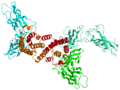 1FG9 IFNG IFNG


Medical Disclaimer: WikiMD is for informational purposes only and is not a substitute for professional medical advice. Content may be inaccurate or outdated and should not be used for diagnosis or treatment. Always consult your healthcare provider for medical decisions. Verify information with trusted sources such as CDC.gov and NIH.gov. By using this site, you agree that WikiMD is not liable for any outcomes related to its content. See full disclaimer.
Credits:Most images are courtesy of Wikimedia commons, and templates, categories Wikipedia, licensed under CC BY SA or similar.
Translate page: - East Asian
中文,
日本,
한국어,
South Asian
हिन्दी,
தமிழ்,
తెలుగు,
Urdu,
ಕನ್ನಡ,
Southeast Asian
Indonesian,
Vietnamese,
Thai,
မြန်မာဘာသာ,
বাংলা
European
español,
Deutsch,
français,
Greek,
português do Brasil,
polski,
română,
русский,
Nederlands,
norsk,
svenska,
suomi,
Italian
Middle Eastern & African
عربى,
Turkish,
Persian,
Hebrew,
Afrikaans,
isiZulu,
Kiswahili,
Other
Bulgarian,
Hungarian,
Czech,
Swedish,
മലയാളം,
मराठी,
ਪੰਜਾਬੀ,
ગુજરાતી,
Portuguese,
Ukrainian

