Interferon
Interferons are a group of signaling proteins produced and released by host cells in response to the presence of several viruses. In a typical scenario, a virus-infected cell will release interferons causing nearby cells to heighten their anti-viral defenses. Interferons belong to the large class of proteins known as cytokines, molecules used for communication between cells to trigger the protective defenses of the immune system that help eradicate pathogens.[1]
Classification of Interferons[edit]
Interferons are classified into three types: Type I (IFN-α and IFN-β), Type II (IFN-γ) and Type III (IFN-λ). The type I interferons are the most widely investigated due to their potent antiviral activities.[2]
Interferon Production and Action Mechanism[edit]
Interferons are produced in response to pathogenic invasions, such as from viruses. When a cell detects the presence of a virus, it releases interferon proteins, alerting nearby cells of the impending danger. The neighboring cells, in turn, ramp up their virus defense mechanisms. Interferons prevent virus replication by degrading viral RNA, inhibiting the synthesis of viral proteins, and causing cells to initiate apoptosis (self-destruction) when they are unable to prevent the virus from replicating.[3]
Role in Immune Response[edit]
Interferons play a critical role in the first line of defense against viral infections. They are also active against bacterial, parasitic, and tumor cells, enhancing the immune response by influencing the communication between cells, inhibiting cell proliferation, and modulating the immune response.[4]
Therapeutic Uses of Interferons[edit]
Interferons have therapeutic applications in treating viral infections such as hepatitis and herpes viruses, cancers including certain types of leukemia and lymphomas, and autoimmune disorders such as multiple sclerosis.[5]
References[edit]
- ↑ Stark, GR."How Cells Respond to Interferons".Annual Review of Biochemistry.1998;doi:10.1146/annurev.biochem.67.1.227.PMID:9646867.
- ↑ McNab, F."Type I interferons in infectious disease".Nature Reviews Immunology.2015;doi:10.1038/nri3787.PMID:25614319.
- ↑ Schneider, WM."Interferon-stimulated genes: a complex web of host defenses".Annual Review of Immunology.2014;doi:10.1146/annurev-immunol-032713-120231.PMID:24555472.
- ↑ Platanias, LC."Mechanisms of type-I- and type-II-interferon-mediated signalling".Nature Reviews Immunology.2005;doi:10.1038/nri1604.PMID:15864272.
- ↑ Borden, EC."Interferons at age 50: past, current and future impact on biomedicine".Nature Reviews Drug Discovery.2007;doi:10.1038/nrd2408.PMID:18049472.
See Also[edit]

This WikiMD article can only be edited by registered and verified editors. You can log in or register.
| DNA virus antivirals (primarily J05, also S01AD and D06BB) | ||||||||||||||||||||||||||||||||||||
|---|---|---|---|---|---|---|---|---|---|---|---|---|---|---|---|---|---|---|---|---|---|---|---|---|---|---|---|---|---|---|---|---|---|---|---|---|
|
| Cell signaling: cytokines | ||||||||||||||||||||||||||||||||
|---|---|---|---|---|---|---|---|---|---|---|---|---|---|---|---|---|---|---|---|---|---|---|---|---|---|---|---|---|---|---|---|---|
|
Interferon[edit]
-
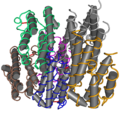 Recombinant Human Interferon-Alpha 2b


Medical Disclaimer: WikiMD is for informational purposes only and is not a substitute for professional medical advice. Content may be inaccurate or outdated and should not be used for diagnosis or treatment. Always consult your healthcare provider for medical decisions. Verify information with trusted sources such as CDC.gov and NIH.gov. By using this site, you agree that WikiMD is not liable for any outcomes related to its content. See full disclaimer.
Credits:Most images are courtesy of Wikimedia commons, and templates, categories Wikipedia, licensed under CC BY SA or similar.
Translate page: - East Asian
中文,
日本,
한국어,
South Asian
हिन्दी,
தமிழ்,
తెలుగు,
Urdu,
ಕನ್ನಡ,
Southeast Asian
Indonesian,
Vietnamese,
Thai,
မြန်မာဘာသာ,
বাংলা
European
español,
Deutsch,
français,
Greek,
português do Brasil,
polski,
română,
русский,
Nederlands,
norsk,
svenska,
suomi,
Italian
Middle Eastern & African
عربى,
Turkish,
Persian,
Hebrew,
Afrikaans,
isiZulu,
Kiswahili,
Other
Bulgarian,
Hungarian,
Czech,
Swedish,
മലയാളം,
मराठी,
ਪੰਜਾਬੀ,
ગુજરાતી,
Portuguese,
Ukrainian


