Triose
- Triose
-
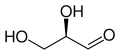 D-glyceraldehyde
 -
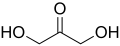 1,3-Dihydroxypropan-2-one


Triose[edit]
A triose is a type of monosaccharide that contains three carbon atoms. The general chemical formula for a triose is C_H_O_. Trioses are the simplest form of carbohydrates and play a crucial role in metabolism.
Types of Trioses[edit]
There are two main types of trioses, which are classified based on the functional group present:
- Aldotriose: This type of triose contains an aldehyde group. The most common aldotriose is glyceraldehyde.
- Ketotriose: This type of triose contains a ketone group. The most common ketotriose is dihydroxyacetone.
Structure[edit]
Trioses have a simple structure with three carbon atoms. In the case of glyceraldehyde, the structure is:
- CH_OH-CHOH-CHO
For dihydroxyacetone, the structure is:
- CH_OH-CO-CH_OH
Role in Metabolism[edit]
Trioses are important intermediates in several metabolic pathways. They are involved in:
- Glycolysis: During glycolysis, glucose is broken down into two molecules of glyceraldehyde-3-phosphate, a triose phosphate.
- Calvin Cycle: In the Calvin cycle, glyceraldehyde-3-phosphate is one of the products of the light-independent reactions in photosynthesis.
Related Pages[edit]
| Types of carbohydrates | ||||||||
|---|---|---|---|---|---|---|---|---|
* Category
|

Medical Disclaimer: WikiMD is for informational purposes only and is not a substitute for professional medical advice. Content may be inaccurate or outdated and should not be used for diagnosis or treatment. Always consult your healthcare provider for medical decisions. Verify information with trusted sources such as CDC.gov and NIH.gov. By using this site, you agree that WikiMD is not liable for any outcomes related to its content. See full disclaimer.
Credits:Most images are courtesy of Wikimedia commons, and templates, categories Wikipedia, licensed under CC BY SA or similar.
Translate page: - East Asian
中文,
日本,
한국어,
South Asian
हिन्दी,
தமிழ்,
తెలుగు,
Urdu,
ಕನ್ನಡ,
Southeast Asian
Indonesian,
Vietnamese,
Thai,
မြန်မာဘာသာ,
বাংলা
European
español,
Deutsch,
français,
Greek,
português do Brasil,
polski,
română,
русский,
Nederlands,
norsk,
svenska,
suomi,
Italian
Middle Eastern & African
عربى,
Turkish,
Persian,
Hebrew,
Afrikaans,
isiZulu,
Kiswahili,
Other
Bulgarian,
Hungarian,
Czech,
Swedish,
മലയാളം,
मराठी,
ਪੰਜਾਬੀ,
ગુજરાતી,
Portuguese,
Ukrainian

