Sternoclavicular joint


[[File: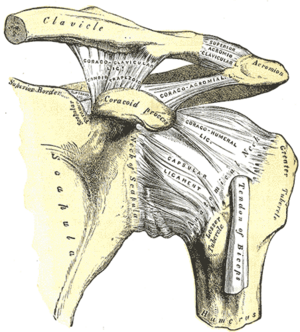 |frameless|alt=]]

| Details | |
|---|---|
| Synonyms | |
| Pronunciation | |
| Carnegie stage | |
| Days | |
| Precursor | |
| Gives rise to | |
| Part of | |
The sternoclavicular joint (SC joint) is a synovial joint between the sternum and the clavicle. It is one of the four joints that compose the shoulder complex, which also includes the acromioclavicular joint, the glenohumeral joint, and the scapulothoracic joint.
Anatomy[edit]
The sternoclavicular joint is a saddle joint but functions as a ball-and-socket joint due to the presence of an articular disc. The joint is formed by the articulation of the medial end of the clavicle with the manubrium of the sternum and the first costal cartilage.
Ligaments[edit]
The stability of the sternoclavicular joint is maintained by several ligaments:
- The anterior sternoclavicular ligament and posterior sternoclavicular ligament reinforce the joint capsule.
- The interclavicular ligament connects the two clavicles across the top of the sternum.
- The costoclavicular ligament anchors the clavicle to the first rib.
Muscles[edit]
Several muscles contribute to the movement and stability of the sternoclavicular joint, including:
Function[edit]
The sternoclavicular joint allows for a wide range of movements, including:
- Elevation and depression of the clavicle
- Protraction and retraction of the clavicle
- Rotation of the clavicle around its longitudinal axis
These movements are essential for the full range of motion of the shoulder.
Clinical significance[edit]
Injuries to the sternoclavicular joint are relatively rare but can occur due to trauma, such as a direct blow to the shoulder or a fall onto an outstretched hand. Conditions affecting the SC joint include:
Imaging[edit]
The sternoclavicular joint can be evaluated using various imaging techniques, including:
See also[edit]
References[edit]
| Joints and ligaments of the arm | ||||||||
|---|---|---|---|---|---|---|---|---|
|
 | This medical article is a stub. You can help WikiMD by expanding the page. |

Medical Disclaimer: WikiMD is for informational purposes only and is not a substitute for professional medical advice. Content may be inaccurate or outdated and should not be used for diagnosis or treatment. Always consult your healthcare provider for medical decisions. Verify information with trusted sources such as CDC.gov and NIH.gov. By using this site, you agree that WikiMD is not liable for any outcomes related to its content. See full disclaimer.
Credits:Most images are courtesy of Wikimedia commons, and templates, categories Wikipedia, licensed under CC BY SA or similar.
Translate page: - East Asian
中文,
日本,
한국어,
South Asian
हिन्दी,
தமிழ்,
తెలుగు,
Urdu,
ಕನ್ನಡ,
Southeast Asian
Indonesian,
Vietnamese,
Thai,
မြန်မာဘာသာ,
বাংলা
European
español,
Deutsch,
français,
Greek,
português do Brasil,
polski,
română,
русский,
Nederlands,
norsk,
svenska,
suomi,
Italian
Middle Eastern & African
عربى,
Turkish,
Persian,
Hebrew,
Afrikaans,
isiZulu,
Kiswahili,
Other
Bulgarian,
Hungarian,
Czech,
Swedish,
മലയാളം,
मराठी,
ਪੰਜਾਬੀ,
ગુજરાતી,
Portuguese,
Ukrainian

