Tegafur

Tegafur[edit]
Tegafur is a chemotherapeutic agent and a prodrug to 5-FU, used in the treatment of various cancers. It is metabolized into 5-FU by CYP2A6, exerting its anticancer effects.
Overview[edit]
- Classification: Chemotherapeutic agent, Fluorouracil prodrug
- Specialty: Oncology
- Mechanism of Action: Converted to 5-fluorouracil, inhibits thymidylate synthase
- Administration: Oral
- Metabolism: Primarily in the liver to 5-FU by CYP2A6
Medical Uses[edit]
As a prodrug to 5-FU, Tegafur is used in the treatment of the following cancers:[1]
- Stomach (when combined with gimeracil and oteracil)
- Breast (with uracil)
- Gallbladder
- Lung (specifically adenocarcinoma, typically with uracil)
- Colorectal (usually when combined with gimeracil and oteracil)
- Head and neck
- Liver (with uracil)[2]
- Pancreatic
It is often given in combination with drugs that alter its bioavailability and toxicity such as gimeracil, oteracil, or uracil.[1] These agents achieve this by inhibiting the enzyme dihydropyrimidine dehydrogenase (uracil/gimeracil) or orotate phosphoribosyltransferase (oteracil).[1]
Mechanism of Action[edit]
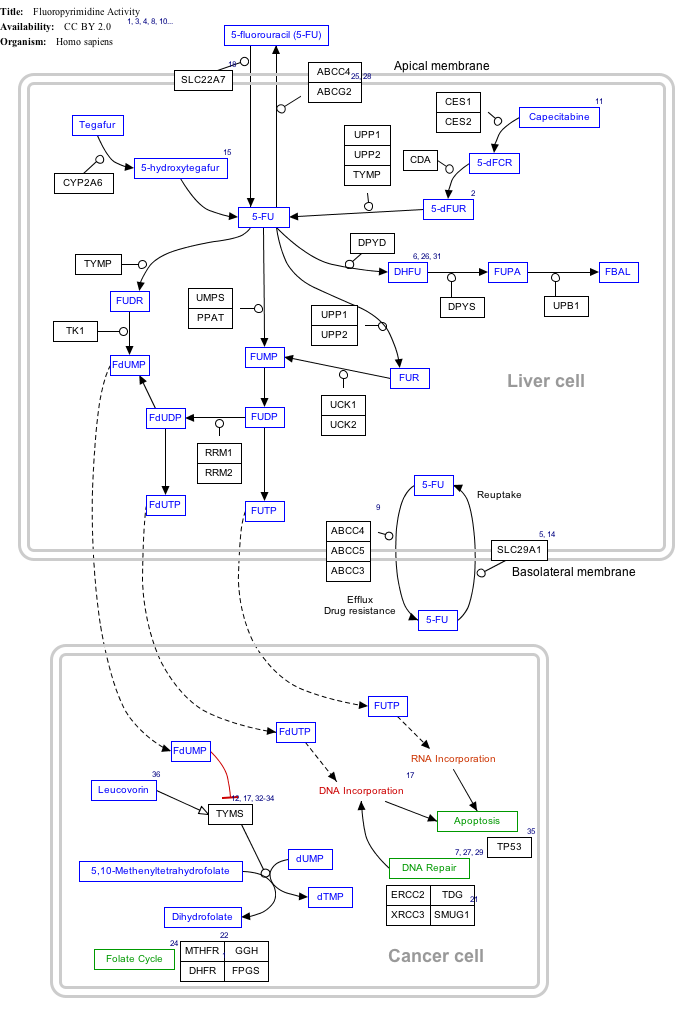
Tegafur is a prodrug to fluorouracil which is a thymidylate synthase inhibitor.[1]
Pharmacokinetics[edit]
Tegafur is metabolized into fluorouracil by CYP2A6.[3][4]
Adverse Effects[edit]
The major side effects of tegafur are similar to fluorouracil and include myelosuppression, central neurotoxicity, and gastrointestinal toxicity (especially diarrhea).[1] Gastrointestinal toxicity is the dose-limiting side effect of tegafur.[1] Central neurotoxicity is more common with tegafur than with fluorouracil.[1]
Interactive Pathway Map[edit]
Click on genes, proteins and metabolites below to link to respective articles.[§ 1]
- ↑ 1.0 1.1 1.2 1.3 1.4 1.5 1.6 Martindale: The Complete Drug Reference(link). Pharmaceutical Press.14 November 2011.
- ↑ Ishikawa, T."Chemotherapy with enteric-coated tegafur/uracil for advanced hepatocellular carcinoma.".World Journal of Gastroenterology : WJG.14 May 2008;14(18)
- 2797-2801.doi:10.3748/wjg.14.2797.PMID:18473401.PMC:2710718.Full text.
- ↑ Nakayama, T."Therapeutic usefulness of postoperative adjuvant chemotherapy with Tegafur-Uracil (UFT) in patients with breast cancer: focus on the results of clinical studies in Japan.".The Oncologist.January 2010;15(1)
- 26-36.doi:10.1634/theoncologist.2009-0255.PMID:20080863.PMC:3227888.Full text.
- ↑ Matt, P."The European Medicines Agency review of Tegafur/Gimeracil/Oteracil (Teysuno™) for the treatment of advanced gastric cancer when given in combination with cisplatin: summary of the Scientific Assessment of the Committee for medicinal products for human use (CHMP).".The Oncologist.October 2011;16(10)
- 1451-1457.doi:10.1634/theoncologist.2011-0224.PMID:21963999.PMC:3228070.Full text.
See Also[edit]
Conclusion[edit]
Tegafur is a crucial chemotherapeutic agent used in the treatment of various cancers. Its effectiveness often relies on combination with other drugs that modulate its bioavailability and toxicity. Understanding its pharmacokinetics, mechanisms of action, and potential adverse effects is essential for healthcare professionals in oncology to optimize patient care and improve treatment outcomes.
See also[edit]
References[edit]

This WikiMD article can only be edited by registered and verified editors. You can log in or register.
Cite error: <ref> tags exist for a group named "§", but no corresponding <references group="§"/> tag was found

Medical Disclaimer: WikiMD is for informational purposes only and is not a substitute for professional medical advice. Content may be inaccurate or outdated and should not be used for diagnosis or treatment. Always consult your healthcare provider for medical decisions. Verify information with trusted sources such as CDC.gov and NIH.gov. By using this site, you agree that WikiMD is not liable for any outcomes related to its content. See full disclaimer.
Credits:Most images are courtesy of Wikimedia commons, and templates, categories Wikipedia, licensed under CC BY SA or similar.
Translate page: - East Asian
中文,
日本,
한국어,
South Asian
हिन्दी,
தமிழ்,
తెలుగు,
Urdu,
ಕನ್ನಡ,
Southeast Asian
Indonesian,
Vietnamese,
Thai,
မြန်မာဘာသာ,
বাংলা
European
español,
Deutsch,
français,
Greek,
português do Brasil,
polski,
română,
русский,
Nederlands,
norsk,
svenska,
suomi,
Italian
Middle Eastern & African
عربى,
Turkish,
Persian,
Hebrew,
Afrikaans,
isiZulu,
Kiswahili,
Other
Bulgarian,
Hungarian,
Czech,
Swedish,
മലയാളം,
मराठी,
ਪੰਜਾਬੀ,
ગુજરાતી,
Portuguese,
Ukrainian


