Datura
Genus of poisonous plants potentially psychoactive
Pronounced da-tu' -rah, [Hind., dhatura, a certain plant], it is a genus of Solanacece, or nightshade family.
Species[edit]
- Dantura arbor ea is a South American spe- cies; the leaves are used as an emollient.
- Dantura ceratocaula is indigenous to tropical America; its properties are similar to those of D. stramonium.
- Dantura fastuosa is found through- out the tropics of the old world.
-
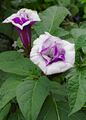 Datura
 -
 Datura metel 'Fastuosa'
 -
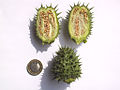 Datura Stramonium Samenkapsel
 -
 Köhler Datura
 -
 Datura stramonium


.jpg)
Traditional Islamic Medicine[edit]
- The root is administered by Mohammedan physicians in epilepsy.
- The fruit, seeds, and leaves are used in poultices for boils, carbuncles, and in the treatment of herpetic diseases. A tincture and decoction are given as a remedy for asthma.
Use[edit]
The plant is poisonous and soporific, and is used in India as an intoxicant, and by professional poisoners for killing newborn female infants ( see female infaticide).
Related species[edit]
- Cf. Dhatureas. D. metel possesses qualities similar to D. fastuosa. D. sanguinea is a South American species, the floripondio of Peru, from the seeds of which an intoxicating beverage called tonga is prepared.
- Taken alone and in large doses it produces furious delirium, but diluted is a soporific.
- The seeds are used in the preparation of an ointment.
- D. stramonium is the thorn-apple. See Stramonium.
|
|
This article is a stub You can help WikiMD by registering and expanding it with useful details, internal links, formatting, and categories. Editing is available only to registered and verified users. WikiMD is a comprehensive, free health and wellness encyclopedia. |


Medical Disclaimer: WikiMD is for informational purposes only and is not a substitute for professional medical advice. Content may be inaccurate or outdated and should not be used for diagnosis or treatment. Always consult your healthcare provider for medical decisions. Verify information with trusted sources such as CDC.gov and NIH.gov. By using this site, you agree that WikiMD is not liable for any outcomes related to its content. See full disclaimer.
Credits:Most images are courtesy of Wikimedia commons, and templates, categories Wikipedia, licensed under CC BY SA or similar.
Translate page: - East Asian
中文,
日本,
한국어,
South Asian
हिन्दी,
தமிழ்,
తెలుగు,
Urdu,
ಕನ್ನಡ,
Southeast Asian
Indonesian,
Vietnamese,
Thai,
မြန်မာဘာသာ,
বাংলা
European
español,
Deutsch,
français,
Greek,
português do Brasil,
polski,
română,
русский,
Nederlands,
norsk,
svenska,
suomi,
Italian
Middle Eastern & African
عربى,
Turkish,
Persian,
Hebrew,
Afrikaans,
isiZulu,
Kiswahili,
Other
Bulgarian,
Hungarian,
Czech,
Swedish,
മലയാളം,
मराठी,
ਪੰਜਾਬੀ,
ગુજરાતી,
Portuguese,
Ukrainian

